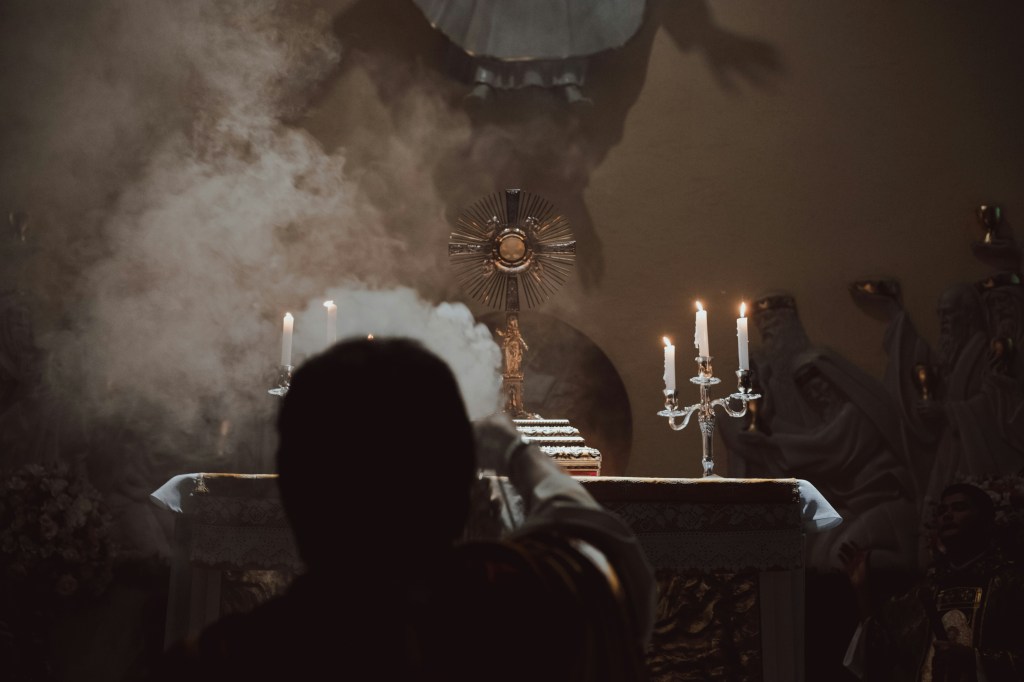
The Perfume of Ashes
A little while ago, I wrote a short story called Blood & Smoke. It was an attempt to drag sacrifice out of the realm of tidy doctrine and back into flesh and fear. I wanted readers to feel the heat of the altar, to smell iron and ash, to watch a body tremble and fall still. To remember that “sacrifice” was not metaphor. It was death. It was blood. It was something killed deliberately, reverently, publicly, because people believed that life spilled out could somehow speak to God.
When I was a Christian, I was taught to see all of this as sacred foreshadowing. The Old Testament sacrificial system was presented as a divine blueprint, a symbolic grammar that Jesus would one day fulfil. Animal sacrifice, I was told, was never really about animals at all. It was prophecy in motion. Every bull, goat, and dove shedding blood in order to point towards “the Lamb slain from the foundation of the world.”
But revisiting these ideas, I realised how emotionally insulated we have become from sacrifice itself. We sing about “atonement” and “the blood of the lamb”, yet rarely pause to imagine what it means to cut a throat, to hear strangled breath, to watch warm life drain into dust. Writing Blood & Smoke was my attempt to return to that ancient world as lived experience rather than abstract theology. Breath and heat, trembling flesh and thick smoke curling into the sky.
In the story, a boy stands before an altar and witnesses a goat die. And in that moment, he steps into something profoundly human and profoundly ancient: the belief that death offered carefully, ritually, might move the divine. And that raises a destabilising question when we turn back to Scripture itself. If that sacrifice had taken place in a Canaanite shrine instead of an Israelite temple, would it have looked any different? And if not, what does that do to our assumptions about ancient Israel’s religious uniqueness and the later Christian claim that this whole sacrificial universe was secretly about Jesus all along?
Those questions pull us into deeper, more uncomfortable territory. They ask us to look at the roots of Israel’s religion, at the meaning of sacrifice itself, and at the way Christianity later seized this language of blood and ritual and made it central to its story of salvation.
Sacrifice as Shared Religious Language
For a long time, Christian and Jewish imagination painted Israel as a people set apart from their earliest beginnings. A distinct culture, radically unique in faith, divinely quarantined from the “paganism” of Canaan. The Canaanites sacrificed in darkness and superstition. Israel, we were told, sacrificed in covenant and divine revelation.
Yet when we start to listen to historians and archaeologists, a different picture emerges. The early Israelites do not appear in the land as alien invaders sweeping everything away. Instead, they look very much like Canaanites themselves. Their pottery, their houses, their tools, their language, even their diet all sit comfortably within the wider Canaanite world. Rather than strangers arriving with a fully formed and ready-made religion from elsewhere, they seem to be local people gradually growing into a new identity.
If that is true, then when early Israelites built altars, slaughtered animals and burned offerings, they were not inaugurating some entirely new religious system. They were participating in the same sacrificial culture that shaped their neighbours. Blood, smoke, priests, altars, sacred gestures, these are not uniquely Israelite markers. They are the common grammar of religion in the ancient Near East.
Sacrifice in that world was not a strange or occasional act. It was the normal way of doing business with the gods. It mediated the relationship between heaven and earth. It maintained cosmic order. It redistributed meat and reaffirmed social hierarchies. It marked festivals, sealed covenants and soothed troubled consciences. When an animal died on the altar, something was believed really to happen, guilt was lifted, favour was sought, blessing was secured.
The Old Testament sacrificial system sits squarely inside this world. Burnt offerings, peace offerings, sin offerings and guilt offerings all have clear parallels in the rituals of other Canaanite and West Semitic cultures. Even the way Leviticus describes God “smelling the pleasing aroma” of the sacrifice makes sense only in a world where gods were widely imagined to enjoy the scent of burning fat and flesh. This is not mere poetic language. It is the religious imagination of the region.
This does not mean Israelite worship was simply “the same” as everyone else’s. But it does mean we cannot honestly pretend that Israel’s sacrifices were some completely different thing, untouched by their context. If we stood in the courtyards of a Canaanite shrine and an Israelite sanctuary on the same morning, we would see more similarity than difference. The same fear and reverence, the same blood on stone, the same acrid smoke painting the sky.
Leviticus and the World of Blood
This is why Leviticus can feel so alien to us. It is not a book of abstract ideas. It is a handbook for priests working with blood. Modern readers often find it dry, obscure or legalistic, but beneath its careful instructions lies a very vivid world, one in which life is precarious and holiness dangerous.
“The life of a creature is in the blood,” says Leviticus. Blood, in that imagination, is not just a bodily fluid. It is life-substance. It belongs to God. It is powerful, dangerous, cleansing and polluting all at once. It must be handled carefully, spilled only in the right ways, in the right place, for the right reasons.
The priests of Israel stood in that world with knives in their hands and blood on their garments. They did not simply “illustrate” forgiveness or “symbolise” reconciliation. They believed they were working something real. Atonement was not a metaphor. It was a transaction in life-force. An animal’s life stood in place of the worshipper’s. Its blood was daubed, sprinkled, flung. Its fat was burned. Its flesh sometimes eaten, sometimes entirely consumed in flame. And through these actions, the relationship between God and people was maintained, repaired, strengthened.
If we understand “magic” in its older sense, that is to say, a ritual action believed to have real spiritual effect, then describing this as akin to “pagan blood magic” may be a more accurate depiction than not.
What unfolded there was not mere theatre but a choreography of power, a ritual grammar through which people believed the unseen world could be persuaded to incline towards them. Every measured gesture, every spill of crimson, every rising column of smoke was part of a negotiated exchange with the sacred. Guilt loosened, favour drawn near, danger held at bay. The altar became a place where death was handled like a dangerous instrument, wielded with reverence because it was believed to work. And once we see it in those terms, the tidy distance disappears. We find ourselves standing in the same strange territory we are so quick to condemn in others, where blood is charged with potency and mortality itself becomes a language spoken to heaven.
When we sanitise this world, we not only do an injustice to the text, we also risk misunderstanding Christian language itself. Phrases like “Christ is the sacrifice for sin” or “the blood of Jesus cleanses us” are not neutral metaphors. They are borrowed from a very particular world, a temple courtyard where throats were cut and bodies burned. Even if I no longer share the faith that uses that language, I can see that its liturgies and hymns are still haunted by that earlier world of blood and smoke, whether we choose to acknowledge it or not.
Death Passes Over
If all this already makes us uneasy, there is a darker question that sits beneath it.
What about human sacrifice?
Christian teaching has often reassured us that Israel’s sacrificial system was ethically distinct from surrounding religions precisely because it rejected the offering of human lives, especially children. We learned that child sacrifice belonged to the cult of Molech, to “the nations”, to the horrors from which God rescued his people.
But the biblical story, when we read it carefully, does not draw such a neat line.
Molech is the biblical villain of child sacrifice. He stands as a theological scapegoat for everything Israel comes to define itself against. People did not sacrifice children to Yahweh, later theology insists. They sacrificed them to Molech. But modern scholarship increasingly questions whether Molech was truly a distinct foreign deity, a distorted memory, a polemical reframing of older Yahwistic practices that came to be theologically disowned, or even a mistranslation of earlier rites. And once we acknowledge that any of these might be true, the comfort of pushing this horror safely outside Israel’s own religious life becomes far harder to sustain.
The Binding of Isaac in Genesis 22 is perhaps the most famous and unsettling example. God commands Abraham to offer his son, his only son whom he loves, as a burnt offering. The narrative turns, of course, on the last-minute provision of a ram in Isaac’s place. Yet for the story to have any force at all, the idea of a father sacrificing his child to God has to be imaginable. Abraham does not argue, protest or accuse God of cruelty. He gets up early, prepares the wood, binds Isaac and lifts the knife. The drama lies not only in God’s mercy but in Abraham’s terrifying readiness.
What complicates this further is how Abraham is often presented in Christian interpretation as an exemplar of unwavering faith at precisely this moment. We are sometimes told that Abraham trusted that God would somehow provide, that he knew Isaac would not ultimately die, that this was faith triumphing over sight. Yet when we read the wider Abraham stories, he is hardly a consistent portrait of such serene conviction. He doubts the promise of a child and fathers one with another woman. He twice attempts to save himself by passing his wife off as his sister, seemingly willing to risk her safety to protect his own skin. In so many other moments Abraham acts out of fear, uncertainty and strategic compromise. If the Christian reframing is right, then Abraham suddenly becomes uncharacteristically full of faith here of all places, precisely when he is being asked to perform an act so morally horrifying that most of us today can barely contemplate it.
Later interpreters, Jewish and Christian alike, have often read this story as God’s way of finally saying, “No, I do not want human sacrifice.” That is certainly one way to hear it now. But the bare narrative does not spell that out with the clarity many of us might wish it did. What it does show, without flinching, is that human sacrifice sits inside the story’s horizon of possibilities. God is not shocked by Abraham’s willingness. God is impressed. And that remains deeply troubling, however we try to explain it away.
Then there is Jephthah’s daughter in Judges 11. Jephthah vows that if the Lord grants him victory in battle, he will sacrifice whoever comes out of his house to meet him when he returns. It is his daughter who runs out to greet him, dancing with tambourines. The text is painfully, almost brutally simple: “He did to her as he had vowed.” There is grief, there is lament, but there is no divine interruption, no explicit condemnation. The story does not tell us, “This was wrong.” It simply tells us that it happened, that Jephthah believed he had to go through with it, and that his daughter submitted.
Later readers have struggled with this so much that many have tried to explain it away as something less than literal sacrifice, perhaps a dedication to lifelong virginity. But read in its own context, in a world where vows to God were deadly serious, the story looks very much like a human offering carried through.
Alongside such narratives sits a thread running through the law itself. The firstborn belongs to God. Several passages speak as though the life of the firstborn, animal and human, is God’s rightful due. Later legal texts then bring in the idea of redemption, of “buying back” the firstborn son with a substitute, usually an animal. That pattern is morally reassuring to us, but we should notice that it presupposes a more frightening logic. That the child’s life is genuinely at stake unless redeemed.
And this raises another unsettling question when we think of the Exodus story. The tenth plague is often remembered as judgement against Egypt, an act of liberation for Israel. But viewed through the lens of sacrificial logic, it bears an uncanny resemblance to something much darker. The firstborn of Egypt die by the hand of the “Angel of the Lord”, a sweeping act of divine violence aimed explicitly at children. Israel, we are told, escapes not because their firstborn are exempt by nature, but because blood marks their doors. Had they failed to daub their lintels, their sons too would have fallen. Whatever theological meaning later faith traditions find in that story, its narrative shape sits disturbingly close to the world of sacrifice. Death passing over some homes because blood has already been offered, life spared because death has already been acknowledged. Here again, the logic whispers the same unsettling truth. The firstborn belong to God. The only question is whether their lives are taken, or bought back at a price.
Prophets like Jeremiah and Ezekiel rail against those who “burn their sons and daughters in the fire”, and kings are condemned for “making their sons pass through the fire”. These actions are denounced, and they are associated with apostasy and judgement. Yet the vehemence of the language itself suggests that such practices were more than marginal rumours. We do not shout so loudly about temptations no one feels.
In one of the most disturbing passages, Ezekiel has God say of Israel, “I gave them statutes that were not good and laws by which they could not live; I defiled them through their gifts—the sacrifice of every firstborn—that I might fill them with horror.” However we interpret this, it acknowledges that the sacrifice of firstborn children actually happened as part of Israel’s religious life. It is not described as some foreign custom over there. It is described as Israel’s own distorted worship.
All this suggests that human sacrifice, especially the offering of children, was not simply “what the others did”. It was a haunting possibility within Israel’s own religious imagination, sometimes acted upon, later renounced, and then retrospectively pushed onto the shoulders of other gods like Molech as Israel’s theology developed.
By the time of the great reforms under kings like Hezekiah and Josiah, and certainly after the trauma of the Babylonian Exile, child sacrifice is treated as an unthinkable horror, a sure sign of national apostasy. Judaism’s later moral clarity on the matter is real and important. But like monotheism itself, that clarity seems to have been forged through history, argument and revisionism. It was not present in its full form from the beginning.
Reform, Exile and Rewriting the Past
Once we begin to see this, the Bible’s own internal tensions come into focus. Early poetry and narrative sometimes speak as though other gods are real and present, with Yahweh standing among them as superior. Ordinary household religion appears to have involved not only Yahweh but other divine figures tied to fertility, land and family life. Sacred trees and high places dotted the hills. Local shrines and altars carried on older traditions.
Later, a series of reform movements begin trying to pull this diverse and untidy religious world into line. Deuteronomy calls for worship to be centralised in one chosen place. Local shrines are condemned. Symbols of earlier practice are to be removed. Kings who destroy altars and desecrate high places are celebrated as faithful; those who tolerate them are judged as compromised. What had been ordinary devotion for generations is suddenly recast as betrayal.
This is not a simple tale of Israel bravely resisting foreign influence. It is a story of Israelites arguing with other Israelites about what loyalty to Yahweh truly means. The prophetic condemnations of “Canaanite” practices are not primarily attacks on outsiders, they are aimed squarely at the heart of Israel’s own life.
The Babylonian Exile intensifies this struggle immeasurably. With the temple in ruins, the monarchy gone, and the people scattered, Israel is forced into questions it had rarely faced so starkly. Who are we without land? Without a king? Without a sanctuary? And perhaps most dangerously, where is our God in the midst of national humiliation?
In that crisis, something transformative happens. Traditions are gathered, edited and retold through the lens of catastrophe. What had once been a varied and regionally diverse religious landscape is gradually distilled into a more disciplined and unified self-understanding. Israel begins to imagine itself not simply as a nation with a powerful god among others, but as a people belonging to the only true God, sovereign not merely over Israel but over history itself.
Before exile, Israel’s faith often resembles what scholars call monolatry. Devotion to one god above others. Yahweh is supreme, yet still spoken of at times as if among a wider assembly of divine beings. In exile, this shifts. The crisis demands more than allegiance to a tribal or national deity. If Yahweh were merely one god among many, their defeat might imply His defeat too. Instead, theology stretches to meet the disaster. Yahweh becomes not just Israel’s God, but the God of heaven and earth, Lord of empires, creator of all. Other gods fade until they become “no gods” at all. They are idols, illusions, empty pretenders.
In this fuller sense, monotheism crystallises in the liminal space of dispossession. It becomes a way of surviving. Israel may have lost everything visible, but the transformation of Yahweh from a warmongering tribal deity to the ruler of the universe functions to put him beyond the reach of earthly empires. He cannot be dethroned because there is nowhere He does not rule. Where pagan gods were tied to territory, Yahweh becomes boundless.
This theological shift also becomes the foundation of communal cohesion. If there is no king, God becomes the centre. If there is no temple, law and memory and prayer take its place. Identity no longer rests on geography or political power, but on shared story and covenant. A faith once anchored in land and altar becomes portable; it can be carried in texts, rituals and discipline. Israel does not merely preserve its faith in exile. It remakes its deepest claim so that faith can endure.
In retelling its past with this sharpened clarity, Israel also interprets its earlier religious life anew. Practices once ordinary now read as shameful compromises. Stories that once simply described reality become warnings of what must never happen again. The messy truth of shared Canaanite roots and multiple expressions of worship fades, and what remains is the memory of a people always meant to be distinct. Chosen not simply by a powerful national god, but sustained by the only God there is.
But identity forged in survival is never only about belief. It is about memory. Once Israel came to see its God as the sole ruler of history, the catastrophe of exile could not simply remain an inexplicable accident. It demanded meaning. If Yahweh truly governed all things, then defeat had to say something about Israel, about covenant, about failure and fidelity. The story of the past could not remain as it was. It had to be re-read, re-ordered, re-theologised, so that the present could make sense and the future could be imagined at all.
The exile required theological explanation. Failure demanded meaning. A new identity had to be forged that could survive displacement. And in this reconstruction, ritual itself was reinterpreted. Sacrifice remained, but its meaning shifted. Blood was no longer simply cosmic currency or ritual potency, it became moral cleansing, covenant loyalty, identity performance. The sacrificial system, already ancient, was given new theological depth through retelling.
Texts were edited, rearranged and interpreted to tell a story of chosenness, covenant fidelity and divine jealousy. Israel’s repeated “Canaanite backsliding” became the narrative explanation for catastrophe. The past was reshaped as moral biography. Religion became boundary. Jewish identity began to coalesce around memory and law rather than shared Levantine culture.
The sacrificial system survived conceptually even after the Temple was gone, eventually transforming instead of disappearing. Ritual bloodshed gave way to prayer, Torah and ethical life, but this evolution only underscores the fact that Judaism’s identity has always been forged in response to history, not detached from it.
Christianity’s Great Reversal
It is into this already layered and contested landscape that Christianity arrives. The first Christians were Jewish men and women living in the late Second Temple period, steeped in Scripture, temple symbolism and hopes of restoration. When Jesus was executed as a criminal on a Roman cross, they faced a theological crisis not unlike the Exile, albeit on a different scale. If this man was God’s anointed, how could his story end like this?
One of the most powerful answers they found was in the language of sacrifice.
Christianity does not encounter Israel’s sacrificial system as a dead relic. It encounters it as living memory, contested theology, and a potent symbol of redemption. And instead of leaving sacrifice where it historically belonged, Christianity gathers it up into an entirely new direction.
Paul, writing only a couple of decades after Jesus’ death, begins to talk about the cross not simply as a miscarriage of justice or a martyr’s fate, but as an event with sacrificial meaning. Jesus is described as a Passover lamb, as one through whose blood God sets people free. His death becomes a place where sins are dealt with, where God’s righteousness is revealed, where a new covenant is established. Paul draws freely on the imagery of temple, altar, lamb and priest, and bends it towards the crucified Messiah.
This was not a small move. In doing so, the early Christians were not merely adding a layer of emotional poetry to Jesus’ death, they were reshaping the very meaning of “Messiah”. Because in first-century Judaism, “Messiah” did not mean what most Christians assume today. The Messiah was not expected to be a divine figure whose primary purpose was to die for the sins of the world. He was imagined as a kingly, earthly deliverer. A descendant of David who would restore Israel’s sovereignty, defeat oppressors, rebuild the Temple, and inaugurate an age of righteousness and peace. The Messiah was meant to succeed in history, not die shamefully before the story even began.
A crucified Messiah, therefore, was not simply tragic, it was theologically incoherent. Crucifixion was Rome’s way of saying, “This man is not only defeated but humiliated. His cause is finished. His memory is disgraced.” It was a punishment designed not only to torture the body but to erase credibility, to strip away honour, to broadcast failure.
If Jesus had simply been remembered as an executed rebel or failed teacher, the movement should have withered. Instead, the earliest Christians did something astonishing. They turned defeat into destiny. They shifted from a Messiah who was supposed to conquer through power, to a Messiah who conquers precisely through suffering. The sacrificial imagination provided the framework. If the Messiah’s death could be read not as accident, but as a prophesied sacrifice… If his blood could be understood as cleansing, covenant-making, world-healing, then the cross was not a scandal to be explained away, but the very centre of God’s plan.
In that reframing, shame was undone. What Rome meant as public degradation was transformed into holy offering. What looked like failure became victory. And with this theological innovation, the earliest Christians not only redeemed the image of a Messiah who had “failed” by ordinary Jewish expectations, they also cleansed the wound of crucifixion itself, baptising it in sacrificial meaning until agony became glory and execution became salvation.
The letter to the Hebrews goes further still. It does not just say that Jesus’ death is like a sacrifice. It claims that the entire sacrificial system was always meant to be a foreshadowing of him. Priests, tabernacle, rituals and blood are all described as “shadows” of a heavenly reality. Jesus is presented as both high priest and sacrificial victim, entering the true holy place, not with the blood of animals, but with his own. In that act, says Hebrews, he accomplishes “once for all” what repeated sacrifices never could.
Then the book of Revelation lifts this imagery onto a cosmic stage. Christ appears there as “the Lamb who was slain”, an identity rather than just an event. This Lamb is worshipped at the centre of heaven’s throne. He conquers not through the sword but through his own suffering. At one point he is called “the Lamb slain from the foundation of the world”, as if sacrifice itself lies somehow at the heart of creation’s story.
Put together, these early Christian writings perform a remarkable theological move. They do not simply borrow sacrificial language to describe Jesus. They reverse the direction of interpretation. Sacrifice in Israel had once been about maintaining covenant and holiness in this world, restoring relationship with God, cleansing impurity, expressing devotion. Christianity turns around and says, all of that was actually about him. The goat on the altar in Leviticus, the lamb at Passover, the blood sprinkled on the mercy seat, even the troubling stories of firstborn sons and near-sacrifices. All of it becomes, in retrospect, a vast mosaic painstakingly assembled to point to one crucifixion on a hill outside Jerusalem.
In doing this, Christianity binds itself very tightly to Israel’s Scriptures and rituals. It cannot tell its story without them. But it also, perhaps unintentionally, makes it harder to see ancient Israel’s religion in its own right. The actual history of how Israel’s practices arose, how they changed, how they resembled those of their neighbours, becomes secondary to the grand theological claim that God had always been arranging everything to prefigure Christ.
Pagan Blood Magic
To call Israelite sacrifice “pagan blood magic” is provocative, but it needn’t be dismissive. Sacrifice in both Canaanite and Israelite contexts was not mindless brutality or crude manipulation of the divine. It was profoundly social, theological and relational. Yet it was also undeniably violent, visceral, and grounded in belief about the power of blood, precisely the kind of sacred violence modern religious sensibilities often sanitise.
Recognising the similarities does not undermine Jewish theological tradition, it contextualises it. It reminds us that Judaism and Christianity, like all religions, grew out of shared human soil, borrowing, adapting and reshaping symbols rather than descending ready-made from heaven. To acknowledge that Israel participated fully in this sacrificial universe is not to diminish it. On the contrary, it places Israel within the deep human struggle to negotiate guilt, power, fear, and hope in a dangerous world. It also highlights what truly makes later Jewish developments remarkable. Israel did not begin as utterly unique. It became unique. Its distinctiveness emerged historically, through reform, trauma, reflection and reinterpretation.
When I use the phrase “pagan blood magic”, I do so deliberately as a rhetorical mirror rather than a sneer. It is a phrase soaked in Christian polemic. For centuries, Christian thought, and before it, certain strands of biblical theology, cast non-Israelite religion as primitive, morally degenerate, dark and superstitious. The sacrifices of Israel’s neighbours were framed as barbaric rituals performed in ignorance, while Israel’s were seen as divinely revealed worship, qualitatively different in kind rather than merely similar in form.
This is precisely the move the Deuteronomistic authors make. They do not deny that Israel once shared a sacrificial and cultic world with the peoples around them. Instead, they rewrite that shared world into a story of tragic deviation. What was once normal religious practice becomes, in retrospect, apostasy. What was once culturally continuous becomes morally abominable. By labelling Canaanite ritual as depraved, Israel is able to narrate itself as morally and theologically superior, even when the archaeological and textual record suggests deep entanglement rather than separation.
Christianity inherits this rhetorical habit and amplifies it. As the faith expanded into the Greco-Roman world, Christian writers increasingly framed pagan temples, sacrifices and rituals as the epitome of spiritual darkness. Pagan altars became sites of demonic influence. Pagan priests became deceivers or deluded victims. Pagan sacrifice became the very symbol of religious ignorance. In demonising the religious practices of “others”, Christianity strengthened its own self-understanding as the place where God’s true revelation and moral clarity resided.
There is deep irony in that. Because when we strip away the theological justifications and look at form, practice and ritual imagination, Christianity does not stand outside this world of sacrificial religiosity. It participates in it. The Christian story of salvation is built on blood, offering, appeasement, and ritual consumption. The cross is interpreted through sacrificial grammar. The Eucharist (and the different forms in which it is performed throughout Christendom) reenacts participation in a sacred death. The theological world in which this makes sense is not less mythic or less ritualised than the religions Christianity condemns, it is simply differently narrated and granted divine legitimacy rather than labelled superstition.
That is why the phrase “pagan blood magic” matters rhetorically. It exposes the circular logic by which a tradition normalises its own sacred violence while condemning the very same kinds of ritual when practised by others. It reveals that what gets called “pagan” is often merely someone else’s deeply meaningful religious life viewed from the outside, stripped of legitimacy by those who benefit from the narrative of moral superiority.
Seen this way, Christianity’s sacrificial theology is not the antithesis of “pagan religion”. It is one of its most intricately developed forms. And acknowledging that does not demean Christianity, it simply places it back into the shared human landscape from which it emerged.
This habit of demonising the religious “other” is not confined to the ancient world. It is alive and well. Jamaica, the land of my birth, is famous for many things. One of its lesser-known distinctions is that it has more Chistian churches per square kilometre than any other nation on earth. Christianity is not simply a religion there, it is cultural air. It shapes speech, public morality, politics, and identity.
Recently, there has been discussion about legalising Obeah, a folk religious tradition of African origin carried to the Caribbean through the trauma of slavery. Like many indigenous spiritual systems, Obeah emerged as both resistance and survival, a way for enslaved people to assert identity, community, and spiritual agency under brutal conditions. Yet in modern Jamaica, the proposal to merely decriminalise its practice was greeted with outrage. Religious leaders denounced it from pulpits. Churchgoers marched. Social media pulsed with prophetic warnings. And when Hurricane Melissa, the most powerful hurricane landfall ever recorded, devastated parts of the island, many were quick to declare it divine punishment. God was angry, they insisted, because the nation dared to flirt with “paganism”.
The echoes of Deuteronomy are hard to miss. A religious majority declares itself morally superior. Alternative spiritual traditions are not simply different, but dangerous, contaminating, demonic. Natural disaster becomes judgement narrative. A community rehearses the same theological reflex Israel once performed toward Canaan: we are the chosen, they are the polluting other and disaster is proof. The irony, of course, is profound. The Christianity doing the condemning is itself built on the very sacrificial, ritual, and mythic structures it seeks to banish. It has simply inherited the privilege of naming its own sacred story “truth” while renaming others’ sacred stories “superstition”.
Seen in this light, “pagan blood magic” is not simply a provocative phrase to be flung at Christianity. It becomes a mirror. It shows how easily any religious tradition can reinterpret its own rituals in sanctity while scapegoating others for doing structurally similar things. It reveals how rhetorical power disguises continuity as contrast. And it reminds us that the line between “holy sacrifice” and “pagan ritual” is often drawn not by some objective divine decree, but by who holds theological and cultural authority to decide what counts as legitimate encounter with the sacred.
Burning Flesh and the Birth of Faith
In Blood & Smoke, the young boy witnessing sacrifice does not encounter a tidy theological symbol. He experiences what countless ancient worshippers felt. Awe, fear, grief, belonging and loss. Something dies. Something is offered. Something shifts in the unseen realm. And in that shift, identity is forged.
So where does this leave those of us who no longer stand within Christian belief, yet still feel its emotional gravity?
For me, it begins with taking the biblical world seriously on its own terms. Israel’s sacrificial system was not a collection of illustrative parables anticipating Christian doctrine. It was a living ritual economy rooted in the same ritual world as Canaan. It involved knives, panic, chanting, blood, and relief. It existed within a worldview where blood held power, where death could purify, where violence could be sacred. At times it likely brushed close to, or crossed into, human sacrifice before later communities drew sharper ethical boundaries.
It also requires acknowledging that Judaism and Christianity did not arrive as finished products. They were contested into being. They were shaped by catastrophe, exile, reform and reinterpretation. Judaism’s later rejection of child sacrifice, its elevation of prayer and ethical life over ritual violence, and its radical monotheism were not original givens, they were hard-won historical achievements. That does not make them less meaningful. It makes them emanations of the very realy human desire for flourishing.
And then we must look honestly at Christianity’s response to Jesus’ execution. Faced with the shame of a crucified would-be Messiah, the earliest Christians made a strikingly imaginative move. They did not discard him as a tragic failure. They rewrote the meaning of his death using the only theological language that, within their world, was large enough to bear the weight of it.
Sacrifice.
His death became atonement. His blood became cleansing. His body became life. The Eucharist ritualised that conviction with almost unsettling literalness. Bread as flesh, wine as blood, consumed in solemn devotion. Christians have often spoken of this as spiritual elegance, profound mystery, holy symbolism. Seen from the outside, it is also a remarkably consistent extension of an older sacrificial imagination.
But if one is willing to label Canaanite religion “pagan blood magic”, integrity demands that we follow the argument through. Israel’s sacrificial system belongs to that same ritual logic. It shares its assumptions about blood, power, guilt and divine appeasement. Christianity does not transcend that world, it extends it. It lifts sacrificial theology to its most elaborate expression, placing a slaughtered Messiah at the centre of cosmic meaning and sanctifying ritual participation in his blood and flesh as the heart of faith. Whatever else one may call this, it is not an escape from the ancient world’s sacrificial imagination. It is its most refined development.
Communion, then, is not a clean break from primitive religion. It is its heir. A community gathers to ritually consume the body and blood of a slain figure whose death is said to bring life. However metaphorically one may now hold that language, it remains rooted in the same sacred logic that perfumed Canaanite shrines and Israelite temples with burning flesh.
Seeing this clearly does not require hostility or contempt. It requires honesty. The smoke rising from ancient altars does not belong to a uniquely pure tradition. It belongs to a shared human attempt to cope with guilt, mortality, anxiety and hope through ritualised death. From that soil Israel emerged. From that soil Judaism was reshaped. From that same soil Christianity cultivated its sacrificial theology of the cross.
What later became doctrine first lived as blood and smoke.
As an agnostic, I no longer feel the need to defend these systems from critique or to transfigure their violence into transcendent beauty. Stripping away illusions of divine exceptionalism does not flatten the story. If anything, it makes it more compelling. Once we allow sacrifice to be what it truly was, human, ancient, earnest, fearful, creative, tragic, we can finally see the continuity. We can see how the figures of the God who “smelled a pleasing aroma” and the Lamb whose blood “saves the world” belong to the same family of religious imagination. We can see how reform and resistance, horror and devotion have shaped what people call “revelation” at least as much as any claimed encounter with the divine.
And perhaps, standing before those ancient fires with clearer eyes, we can respond not with sentimentality but with something steadier. A sober awe at the strange, terrible, beautiful ways human beings have tried to bridge the distance between themselves and whatever they have named as God.

 f2PointEight
Leave a comment